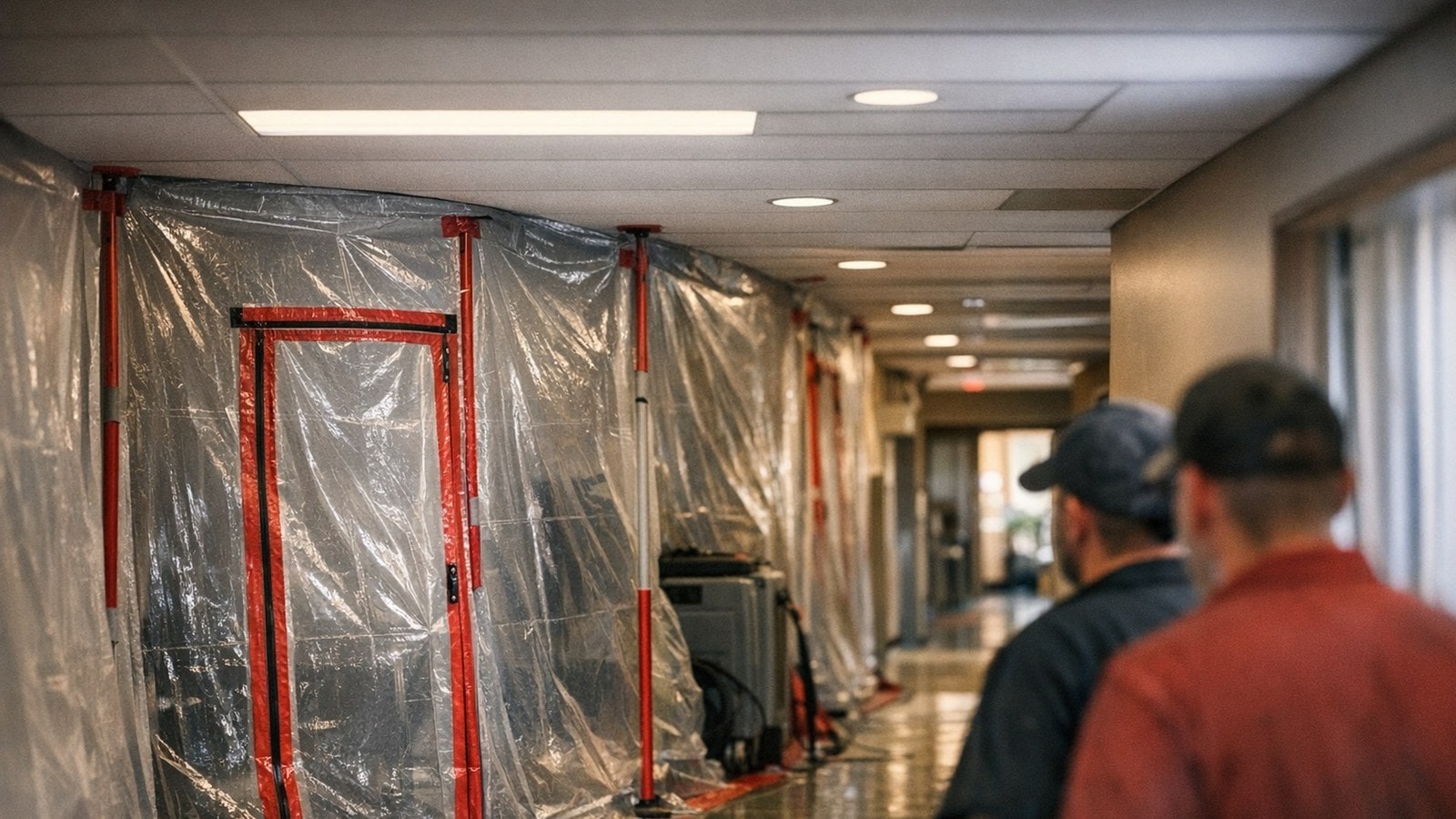
- What happened: Crawford & Company’s Contractor Connection network says 58% of the restoration contractors it surveyed are absorbing higher labor costs to keep prices steady. Only about a third have raised prices.
- What it means for you: If you take carrier or network program work and your rates haven’t moved while your labor costs have, the gap may be coming out of your margin.
- Do this today: Pull your last 10 program jobs and compare their margin to 10 comparable retail jobs of the same type and size before your next rate conversation.
If your carrier or network program rate hasn’t changed in a year, someone is covering the gap between that rate and what your labor now costs. Crawford’s survey of restoration contractors in its own network says the someone is the contractor.
What Crawford’s survey found
- Crawford says 58% of surveyed restoration contractors are absorbing higher labor costs to keep pricing consistent.
- Crawford’s own write-up says only about a third have raised prices.
- Verisk’s data shows billable labor rates up 4.69% in a year, against 2.05% for materials.
- What any of this does to margins. No margin, hourly-rate or contractor pay figure was published.
- How many respondents do mostly program work versus retail work.
- Whether carriers or program managers are absorbing any of the increase.
- Whether plumbing, HVAC, electrical or roofing shops on carrier or warranty programs see the same thing.
Crawford & Company runs Contractor Connection, a managed repair network that dispatches carrier claims to contractors. In an October 8 release, it said its 2026 Managed Repair Market survey found 58% of restoration contractors absorbing higher labor costs rather than raising prices. Crawford’s methodology page says the survey went to restoration specialists in its network in the second quarter of 2026. Nearly 500 responded, and 94.7% of them were owners, managers or executives.
Crawford’s November 10 write-up, run in Claims Journal, adds that only about a third of respondents have raised prices on their jobs. Crawford calls the situation an increasingly unsustainable model for the managed repair ecosystem. That is the network operator’s view. It sells services to carriers, and the numbers are self-reported by firms in its own network. Read it as a signal from one network of water, fire and storm repair firms. It is not an audit of program profits.
Like this? Get it in your inbox every Saturday.
What changed in home services this week, and what it means for your shop.
No spam. Unsubscribe anytime.
You’re in. Check your inbox (and drag us to Primary). 🔑
Labor is running ahead of materials
Verisk, the data firm that tracks reconstruction costs, gives the outside check. Its 360Value analysis says combined hourly billable labor costs across eight tracked trades rose 4.69% from July 2025 to July 2026. Materials rose 2.05%. Labor rates rose in every trade it tracks. Those are billable rates, not what contractors pay their crews, but the direction is clear. Labor is the line that moved most.
Show the data
| Value (%) | |
|---|---|
| Billable labor (8 trades) | 4.7% |
| Building materials | 2.1% |
That matters if your program pays a fixed or scheduled price. The survey doesn’t say every respondent is on fixed rates, or that carriers set each contractor’s pricing, so the logic is conditional: if your program rate stays flat while your actual costs rise, your margin shrinks.
Here’s a hypothetical. A tech costs you $60 an hour fully loaded, and the program pays $95 an hour. That is a 36.8% labor margin. Now assume your loaded cost rises 4.7% to about $62.82. That 4.7% is our assumption for illustration, borrowed from the Verisk billable-rate figure. Verisk did not measure what contractors pay their crews. If the program rate doesn’t move, labor margin falls to 33.9%, or about $282 less per 100 billed hours. This looks only at labor against the billing rate. It is not the whole job’s gross margin, and it leaves out other job expenses and overhead.
Nobody sent you a notice, and no single invoice looks wrong. Materials add to the squeeze separately. A. O. Smith’s planned water heater price increase is one example of supplier prices moving while a program schedule stays put.
Why contractors stay anyway
In the second installment of its survey, Crawford said 74% of contractors named a steady stream of work as the top benefit of managed repair programs. Insurance Business read that as the economic reason contractors stay despite cost pressure. That is a fair reading, but volume is only worth taking if it pays. Falling profit on a work type is easy to blame on demand, and the Ferguson piece makes the case to check margins before blaming demand. The same goes here.
Program jobs can also carry costs worth measuring against your retail jobs: drive time between dispatched jobs, documentation, supervision, callbacks you can’t bill and any fees the network charges. Track them on your program jobs and compare. The fee terms vary by program and contract, so read yours instead of relying on figures from blogs. This is the same discipline as knowing your break-even lead cost. A channel you don’t control has a ceiling, and you should know where yours is.
The comparison only works if the jobs are genuinely comparable. A $35,000 fire restoration and a $3,000 retail water-damage job have different cost structures. Match jobs by type, scope, geography and completion period, then compare contribution after direct costs and program-specific expenses. Treat payment delays as their own line, because cash flow is not the same thing as gross margin.
Crawford says contractors’ willingness to absorb costs may not last, and Insurance Business notes that pressure has to go somewhere. Expect more contractors to ask for rate increases at renewal. Don’t count on a bump unless you bring numbers to ask for one.
A steady stream of work is only worth it if each job still pays. If an insurance program keeps your schedule full but your labor costs keep rising while your rates stay the same, that volume may not be doing your business any favors.
Before your next renewal or rate negotiation, pull your job costs. Compare program work against similar jobs outside the program. Include the labor, documentation, supervision, callbacks, fees and payment delays that are easy to overlook. Then decide what the work is actually worth to your company. Keeping your crews busy and keeping your business profitable are not the same thing.
From the Operator
Being Busy Doesn’t Mean You’re Making Money.
 Joshua T. Osborne · Owner, six home service businesses
Bottom line: I don’t care how many jobs a program sends you. If the rates aren’t keeping up with your labor costs, you’re just working harder for less money. A full schedule means absolutely nothing if you’re not protecting your margins. I’d rather have fewer profitable jobs than a calendar full of work that’s slowly bleeding the company dry.
I’ve seen this problem across home service businesses, and it usually starts with something that sounds pretty good.
Someone comes along and offers you a steady stream of work.
No advertising. No chasing leads. No worrying about where the next job is coming from.
Just keep your crews available, and they’ll send you the jobs.
Sounds like a pretty good deal, right?
Well, that depends on who’s making the money.
One thing I’ve learned operating multiple home service companies is that revenue can hide a whole lot of problems.
You can have trucks running all day, technicians working overtime, and an office that can’t keep up with the phones.
And still barely make a profit.
That’s what caught my attention about this survey.
58% of the restoration contractors surveyed said they’re absorbing higher labor costs rather than raising prices.
Think about that.
Your employees want raises. Your insurance costs go up. Your trucks cost more to operate. Your overhead keeps climbing.
But the company sending you work still expects you to perform the job at last year’s rates.
Somebody’s paying for that difference.
And if you’re not adjusting your pricing, that somebody is you.
Now, I understand why contractors stay in these programs.
Predictable work has value. Keeping technicians busy has value. Not spending thousands of dollars on marketing to generate every job has value.
But there’s a point where that relationship stops making financial sense.
In our plumbing business, we pay close attention to what each truck needs to produce just to cover its expenses.
Our break-even target is roughly $26,000 per truck per month. We want those trucks producing $36,000 or more.
So imagine someone offers to keep one of my trucks busy all month, but the work only generates $22,000.
Am I supposed to be excited because the technician has a full schedule?
Absolutely not.
I’m losing money keeping that truck on the road.
And that’s the trap I think a lot of contractors fall into.
They confuse having work with having a successful business.
Here’s the question I’d ask every contractor taking insurance, warranty, or managed repair work:
If you stopped accepting those jobs tomorrow, would your company actually become more profitable?
Not necessarily bigger.
More profitable.
Because if you’re spending all your available labor on discounted work, you’re also giving up the opportunity to take jobs at your normal rates.
That’s a cost most owners never put on a spreadsheet.
I’m not saying insurance programs are bad. For some companies, they can be extremely profitable.
But I wouldn’t let any single source of work dictate my pricing while my expenses keep climbing.
And I definitely wouldn’t keep accepting jobs just because I was afraid of having an empty schedule.
The goal isn’t to keep your technicians busy. The goal is to build a company that makes money.
Those two things should go together.
When they don’t, something needs to change.
Contractor action checklist
- Pull your last 10 program jobs and 10 comparable retail jobs, matched by job type, scope, geography and completion period, and calculate contribution after direct costs and program-specific expenses on each.
- Calculate your all-in cost per labor hour for program work, including wages, burden, drive time, supervision and unbillable callbacks.
- Track payment timing and network fees separately from margin: note how many days each program takes to pay and what it takes off the top.
- Find the date your program rate last changed, and compare the gap to your own payroll increases over that period.
- Set a floor margin and the share of your capacity you’re willing to give program work before your next renewal conversation.
- Bring your job-level numbers to renewal and ask for a specific rate change, or decide which program jobs to decline.
Get next week's checklist in your inbox.
Every Saturday: what changed in home services and exactly what to do about it.
No spam. Unsubscribe anytime.
You’re in. Check your inbox (and drag us to Primary). 🔑
Sources
- Crawford & Company, 58% of restoration contractors are absorbing higher labor costs (Contractor Connection press release, Nasdaq copy), Oct. 8, 2026.
- Crawford & Company, 2026 Managed Repair Market Report (methodology), 2026.
- Verisk, Reconstruction Costs Show Moderate Shifts, Aug. 1, 2026.
- Crawford & Company, Second installment of 2026 Managed Repair Market report (press release, Yahoo Finance copy), Oct. 21, 2026.
- Claims Journal (Crawford-provided content), Restoration contractors absorbing higher labor costs, Nov. 10, 2026.
- Insurance Business, Restoration contractors absorbing labor costs to hold prices, Crawford survey finds, Oct. 8, 2026.
More on this topic: Business Operations coverage
Disclosure: Digital Insider’s founder, Joshua T. Osborne, owns home service companies and Mr & Mrs Leads, a lead generation company. Some links on Digital Insider may earn us a commission. See our Disclosure Policy.