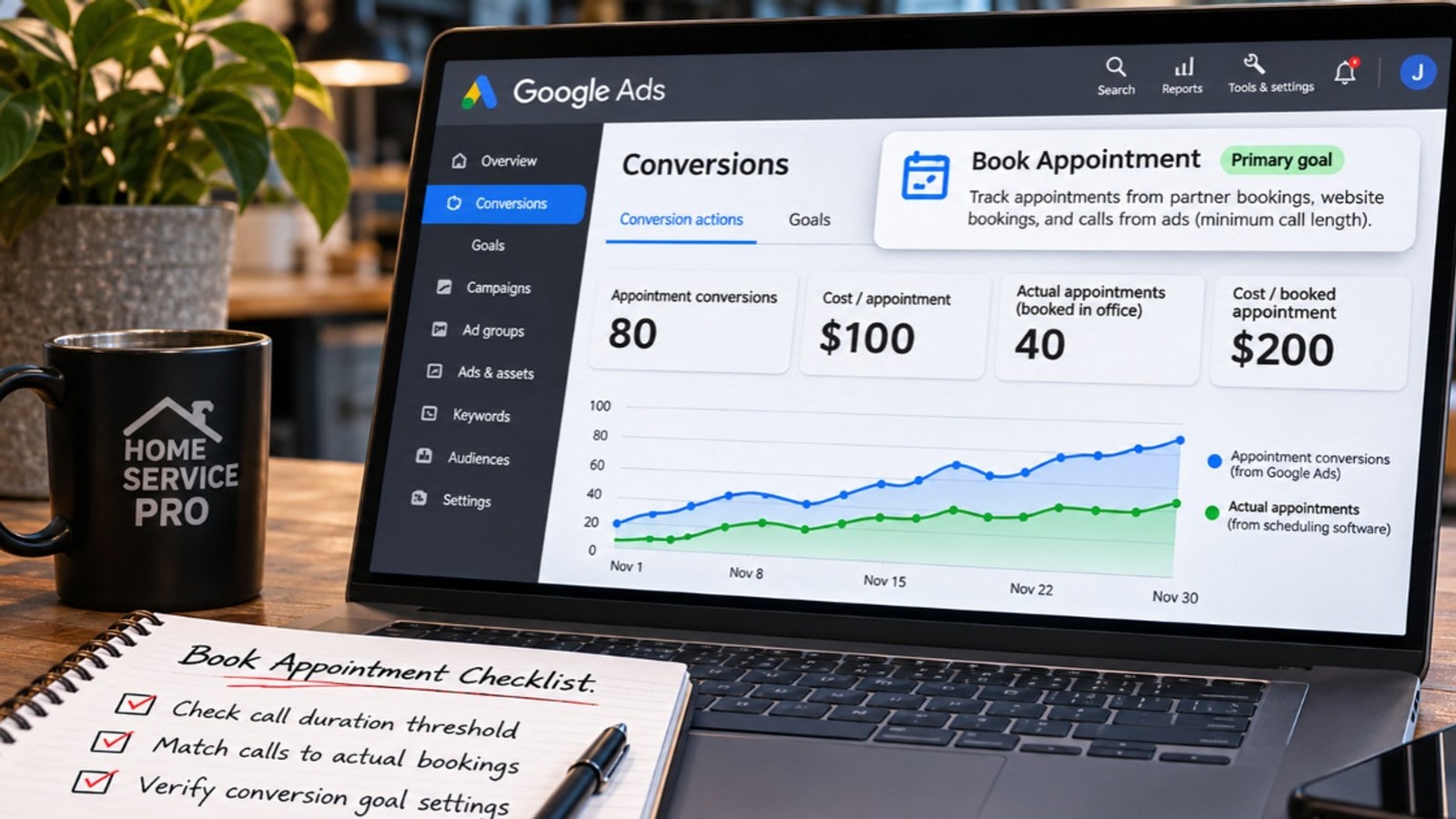
- What happened: Google rewrote its help page for a “Book Appointment” conversion goal. It groups partner bookings, website bookings and phone calls past a minimum length under one label.
- What it means for you: The goal is a regrouping of existing tracking, not a new way to verify booked jobs. A shop that books by phone is still counting calls, and a long call counts whether or not a job was scheduled.
- Do this today: Compare last month’s calls over your length threshold with the jobs your office actually booked before you point bidding at this goal.
How we make money: Digital Insider’s founder, Josh Osborne, owns home service companies and Mr & Mrs Leads, which runs Google Ads and lead generation for contractors. See our Disclosure Policy.
If your Google Ads account optimizes toward calls, you already know the problem: a 20-second wrong number and a $9,000 replacement lead can both show up as a conversion. A “Book Appointment” goal sounds like the fix. For shops that book by phone it isn’t one yet, because one of its three routes still counts calls by length.
Hypothetical Google Ads account
| Monthly ad spend | $8,000 |
| Calls meeting duration threshold | 80 |
| Actual appointments booked | 40 |
| Completed, paying jobs | 30 |
| Google-reported cost per qualifying call | $100 |
| Actual cost per booked appointment | $200 |
Illustration assumes all 80 qualifying calls are counted as appointment conversions, with no additional conversion actions counted.
Same ad spend, two completely different performance numbers. Google can tell you a call lasted 60 seconds. It can’t tell from duration alone whether your CSR booked the customer, and those are two different things. In the example, the dashboard shows 80 appointment conversions at $100 apiece. Your scheduling software shows 40 booked appointments, so the real cost is $200. And if only 30 of those became completed, paying jobs, you’re at about $267 per job.
A rewritten help page, not a new tracker
Search Engine Roundtable reported on Nov. 24 that Google Ads renamed its “About Partner bookings” help document to “About the Book Appointment conversion goal.” Google wrote that the goal “helps you measure and optimize campaigns to drive scheduled appointments, reservations, and service bookings.” Search Engine Land reported the same day that Google expanded its guidance on the goal. PPC News Feed spotted the change a day earlier.
The old page covered only bookings made through Google’s integrated scheduling partners. According to Search Engine Roundtable, the new page lists three ways to count an appointment:
- Partner bookings: appointments made through scheduling software that is integrated with Google.
- Website bookings: a completed booking on your own site, tracked with the Google tag.
- Calls from ads: phone calls from your ads that last at least a minimum length you set. Google’s example is 60 seconds.
- Google renamed and rewrote the help page on or around Nov. 23-24, as Search Engine Roundtable and Search Engine Land reported.
- The page groups three tracking routes under one goal.
- The call route counts calls past a duration you set. Nothing in the coverage describes a check that a job was booked.
- The goal reportedly isn’t applied to a campaign unless you add it or make it an account-default goal.
- Whether a CRM event or offline conversion upload can feed this goal. The three listed routes don’t mention one.
- Whether Google’s AI call-quality scoring applies to calls filed under this goal, or only the minimum-length rule.
- Whether the goal changes how Smart Bidding works. PPC News Feed says it works with Maximize Conversions, Target CPA and Target ROAS, but that comes from trade and vendor coverage.
- Which scheduling partners serve home service businesses, and whether it applies to Local Services Ads.
- Any Google results on cost per booked job. The company has published none for home service accounts.
Like this? Get it in your inbox every Saturday.
What changed in home services this week, and what it means for your shop.
No spam. Unsubscribe anytime.
You’re in. Check your inbox (and drag us to Primary). 🔑
What each route really counts
For contractors relying on calls from ads as their appointment signal, the duration-based method creates the biggest measurement problem. A call that clears your threshold counts as a booked appointment even if the caller was shopping prices, asking about an old invoice or spending five minutes on financing with nothing scheduled. The reverse happens too: a customer can book a drain cleaning in 45 seconds. Hellyeah AI, a vendor, reads the page as counting a partner booking and a 61-second call as one conversion each unless you assign different values. That is the vendor’s interpretation, not Google’s statement, but it is worth testing in your own account.
The website route depends on where the tag sits. Relevant Audience, summarizing Google’s page, says it works through the Google tag plus an event snippet on the appointment confirmation page, with the conversion category set to “Book appointment.” A tag on a “Schedule” button counts clicks, not bookings. A shop without an online scheduler has no confirmation page to tag.
Partner bookings are the cleanest signal, but only if your scheduling software is one of Google’s integrated partners. PPC News Feed reported that AvocaAI, Booksy and Mindbody were added to the list. None of the coverage says whether the field service platforms home service shops use are on it. If you are weighing what your field software lets you export, add “does it report bookings to Google?” to the list.
Relevant Audience also quoted Google’s warning that the goal “isn’t automatically applied to individual campaigns unless set as an account-default goal.” Seeing it in the Goals menu doesn’t mean it is steering bids.
Should you switch the bidding target?
Probably not yet, and not on the strength of the label. Moving Smart Bidding onto a goal full of long-but-unbooked calls teaches it to find more of them. That is the same spend-versus-profit gap we flagged in Google’s returned Local Services Ads numbers. Any “cost per booked job” you calculate from the goal is only as good as the booking behind it, and Google hasn’t shown that figure improves.
Before you switch, look at which conversion actions in your account are primary and which are secondary. Google Ads lets you set each action either way. Primary actions, together with your campaign goals and account-default goals, are what Smart Bidding optimizes toward. Secondary actions are reported but don’t steer bids. In some setups, a duration-based call conversion can stay in place for measurement while a confirmed booking drives bidding, where the campaign’s tracking configuration supports it.
Don’t assume CRM data is shut out just because Google’s appointment-goal page doesn’t list it. Google has separate offline conversion tools for importing calls and leads. Whether an imported action can be assigned to this specific goal isn’t confirmed, so verify it in your account before you build around it.
For a $3 million shop running mostly phone leads, the useful move is a match test. Pull a month of calls that passed your threshold and check how many became booked jobs in your scheduling system. If the match rate is high, the goal is a reasonable proxy. If it is low, the rate shows how much of your reported performance is noise. Either way, that number also feeds your break-even lead cost.
Booking data is also becoming a distribution issue. Google is testing calling home repair businesses on customers’ behalf, and ServiceTitan is building an AI booking channel. A shop that can report real bookings cleanly will be better placed for all of it.
Contractor action checklist
- Open your Google Ads conversion settings and list which actions are counted today: calls, form fills, imported events.
- Pull last month’s calls from ads that passed your length threshold and match them against jobs actually booked.
- Compare booking rates across different call-duration ranges, such as under 30 seconds, 30 to 60 and over 60. Use duration as a preliminary quality signal, not proof of a completed booking.
- Inspect which conversion actions are primary and which are secondary before you switch goals.
- Confirm any website booking tag fires on the confirmation page, not on a button click.
- Ask your scheduling or field software vendor in writing whether it reports bookings to Google as a partner integration.
- Check each campaign’s goal settings and your account defaults before assuming the new goal is steering any bids.
Get next week's checklist in your inbox.
Every Saturday: what changed in home services and exactly what to do about it.
No spam. Unsubscribe anytime.
You’re in. Check your inbox (and drag us to Primary). 🔑
Sources
- Google Ads Help, About the Book Appointment conversion goal, Nov. 24, 2026.
- Search Engine Roundtable, Google Ads Book Appointment Conversion Goals, Nov. 24, 2026.
- Search Engine Land, Google Ads expands guidance on Book Appointment conversion goal, Nov. 24, 2026.
- PPC News Feed, Google Ads Book Appointment conversion goal, Nov. 23, 2026.
- Relevant Audience, Google Ads Book Appointment conversion goal, Nov. 24, 2026.
- Hellyeah AI, Google Ads Book Appointment goal, Nov. 24, 2026.
More on this topic: Digital Marketing coverage
Disclosure: Digital Insider’s founder, Joshua T. Osborne, owns home service companies and Mr & Mrs Leads, a lead generation company. Some links on Digital Insider may earn us a commission. See our Disclosure Policy.